NEMO advances benchmark and demonstration tests for battery model development
The project’s dedicated work package (WP7) focuses on validating and demonstrating the advanced software and hardware developments for next-generation battery management systems.
The NEMO project is advancing battery management systems (BMS) by developing advanced models to improve estimation of State of Charge (SoC), State of Health (SoH), Remaining Useful Life (RuL), and failure detection, aiming to extend battery lifespan. The operational zBMS system is actively collecting data essential for model validation, with a defined cycling protocol as a baseline for upcoming zBMS+ tests. Additionally, project partners have gathered electrochemical impedance spectroscopy (EIS) data under various conditions, including temperature, battery types, and aging states, to ensure the models’ robustness.
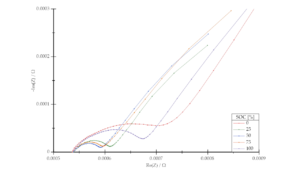
Nyquist Plot of exemplary EIS measurements with the selected NEMO battery cell
To ensure their effectiveness, NEMO’s models must operate under various conditions and undergo rigorous validation.
A key advancement in the project, reported by the WP7 leader Graz University of Technology (TUG), is the development of a framework for standardized data storage in the cloud. This framework facilitates easy access to data for the models and simplifies the comparison of measurement results. Furthermore, the EIS measurement chip has been validated through comparison with an external EIS measurement device, ensuring accuracy in data collection.
The project has also begun initial abuse tests at TUG to develop a failure detection algorithm, enhancing the robustness of the battery management models. Several single battery cells at a SOC of 75% were mechanically abused under laboratory conditions with a hemispherical indenter until occurrence of internal short circuit and thermal runaway at the Battery Safety Centre Graz (BSCG). Measuring the voltage, temperature, indentation force and indentation depth serve as a basis for the following investigations including EIS measurements of battery cells at different levels of uncritical deformation to connect the level of deformation with variations in the electrical battery cell properties.
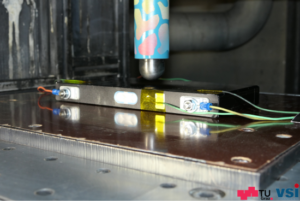
Picture of the test setup before the local mechanical abuse test at 75%SOC

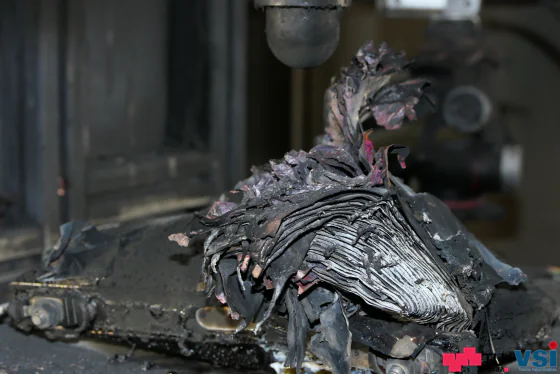
Picture of the cell after the local mechanical abuse test at 75%SOC
Looking ahead, the next steps for the project include the preparation of the zBMS+ system and further testing activities. These will encompass aging campaigns with both cyclic and calendric aging (led by VUB MOBI), swelling experiments (conducted by TUG), and mechanical and thermal abuse tests (also by TUG). The zBMS will undergo cycling at CSEM, while TTTech will focus on cloud implementation.
- VUB MOBI has started a calendric aging study varying the storage SOC from 50% to 100% and the storage temperature ranging from 5°C to 45°C to investigate the evolution of electric battery cell properties. Additionally, several battery cells are under a cyclic aging study including different aging conditions with varying temperature and charging/discharging profiles. Variations of the depth of discharge (DoD) and other parameters create the database for the aging models to be developed in WP4.
- TUG measured battery cell swelling behavior under different conditions by measuring the evolution of battery cell thickness and force. Different constraints (unconstrained and different levels of preload force) were tested and will be linked to electrical battery cell properties to develop the mechanical swelling model within WP3 which allows for an estimation of the mechanical battery state.
Ultimately, the NEMO project plans to conduct a life cycle assessment to evaluate the environmental impact of the battery technologies being developed.
The importance of these benchmark and demonstration tests cannot be overstated. They will provide critical data for model development and benchmarking, validate the NEMO project’s key performance indicators (KPIs), and ensure that the developed models meet the project’s ambitious goals.
—
About TUG
Graz University of Technology plays a pivotal role in the NEMO project, leading efforts in multiple work packages. This includes the development of a mechanical swelling model based on EIS data (MSM), a State of Safety (SoS) estimator leveraging both physics-based and data-driven models for early failure detection (WP4), and leading the validation and demonstration activities within WP7. These combined efforts within NEMO promise to advance battery management technologies, ensuring safer and longer-lasting battery systems.


