Seeing inside the battery: NEMO’s final results are out
As NEMO nears its finish line, the project publishes Seeing inside the battery, a booklet with its key results from 2023 to 2026. It covers six results, from embedded hardware that measures impedance inside the cell to models that forecast ageing, swelling and safety margins, and shows what they mean for Europe’s battery industry.
Most battery management systems (BMS) still work from the outside in. They read voltage and current and infer what is happening inside the cell through simplified models. For three years, NEMO has worked on a different question: what if a BMS could see inside the battery?
The answer is now available in one place. Seeing inside the battery: next-generation BMS for Europe – Key results 2023–2026 brings together the project’s main results. It explains what each result is for, presents the evidence behind it, and sets out how it can be accessed after the project ends.
The question is more pressing than it might seem. Batteries are getting bigger, living longer and moving between first and second lives, and Europe’s battery sector is no longer competing on capacity alone. What increasingly sets players apart is how safe a battery is, how long it lasts, whether it is ready for a second life, and whether the data about it can be trusted. Regulation is pushing the same way. From February 2027, the EU Batteries Regulation will require a digital battery passport, including state-of-health information, for EV and larger industrial batteries. Meeting these demands means knowing what is really going on inside the cell, and that is exactly where a conventional BMS is weakest.
NEMO tackled this blind spot from two sides. On the hardware side, it gave the BMS a way to look inside the cell through electrochemical impedance spectroscopy (EIS), a technique that reveals electrochemical processes that voltage and current alone cannot. On the modelling side, it combined physics-based and data-driven models that turn this richer signal into useful knowledge about the battery. The results presented in the booklet follow that path step by step:
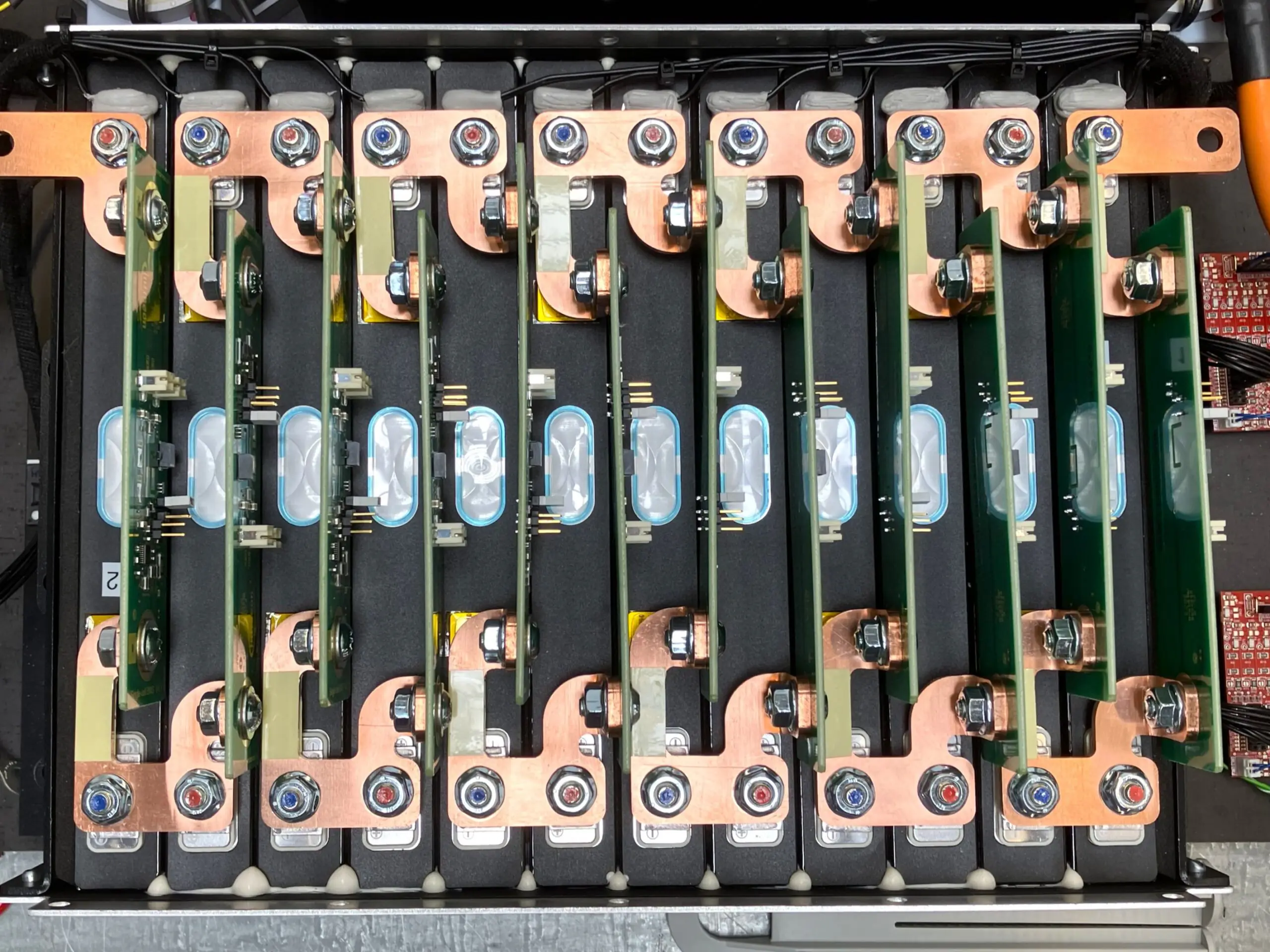
- zBMS, the hardware and software core, developed by CSEM, Infineon and IAV. A working demonstrator measures cell impedance in situ, with a precision of 0.3% on EIS voltage, 1.1% on current and 0.2% on phase.
- Real-time state-of-charge estimation, developed by CSEM. Its Bestimator™ algorithm reached an SoC error (RMSE) of just 0.15% with pulse-based parametrisation, and it stays convergent even when started from the wrong value.
- Internal temperature from impedance alone, developed by CSEM. Cell temperature is estimated without extra sensors, to within about 1.2 °C under dynamic conditions and 0.5 °C at thermal equilibrium.
- Physics-based ageing and swelling models, developed by VUB-SURF and TU Graz. A single extended model predicts both capacity loss and mechanical swelling. It is also implemented in the open-source PyBaMM framework and comes with a public dataset.
- Data-driven and hybrid state-of-health prediction, developed by VUB-MOBI. It reached an average error of 0.63% (R² 0.97) across 16 cycling conditions, spanning first and second life. On the one condition validated so far, adding physics-based inputs cut the error by more than 23%.
- A State of Safety estimator, developed by TU Graz. It goes beyond state of health to detect early signs of damage and forecast safety margins over the battery’s lifetime.
Put together, these results show what a BMS that understands its battery could look like: one that senses more, predicts further ahead and acts earlier, with clear benefits for safety, battery lifetime and second-life use.
Download the booklet to explore the evidence behind each result. For the market context, read the NEMO Market Analysis Info-Pack, Battery intelligence for a changing Europe.
Interested in working with the NEMO partners? Collaboration enquiries are welcome at info@nemoproject.eu.


