

Building Europe’s Battery Ecosystem: Key Takeaways from EUSEW 2026
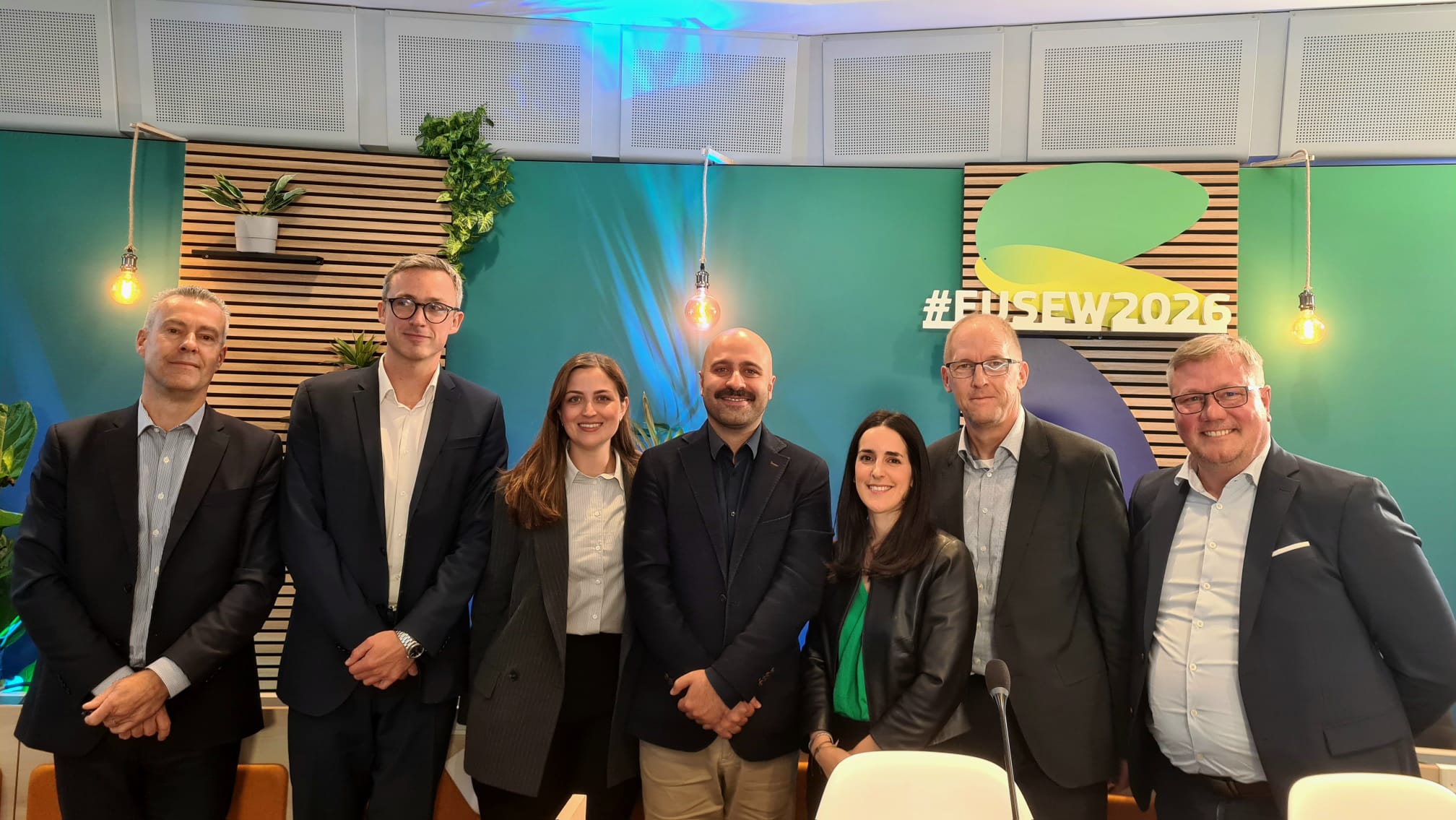
On 10 June 2026, the BMS Alliance cluster co-hosted a session at the European Sustainable Energy Week in Brussels, together with BEPA. Titled “Competitive by Design: Strengthening Europe’s Battery Value Chain Resilience”, the session brought together EU institutions, industry leaders, and Horizon-funded projects for a candid exchange on what it will actually take to secure Europe’s position in batteries.
Here is what we took away.
Competitiveness is not just about capacity, it is about mastery
One of the clearest threads running through the session was that announcing gigafactories is not the same as building industrial capability. Matthieu Hubert (ACC) was direct: ACC is producing real batteries for real customers at its gigafactory near Brussel. The performance is not the problem, the challenge is cost competitiveness. If we are not competitive on the cost of energy and raw materials,he noted, the battery will be expensive regardless
Franz Geyer (BMW Group) echoed the same logic from the OEM perspective: the products are competitive, but the cost gap with Asian producers remains a structural challenge, compounded by regulatory complexity, climate pressures, and the pace of technological change.
Bozorg Khanbaei (BEPA) added an important dimension: manufacturing excellence is not just a cost question. “You cannot make cheap batteries if you do not know how to make batteries; but if you do know how to make them, then you can make cheap ones too.” The argument for gigafactories is ultimately an argument for acquiring and retaining industrial knowledge in Europe. And that knowledge, Mr Khanbaei was clear, cannot be built in isolation: it requires an ecosystem where manufacturing, research, recycling, and policy reinforce one another. Investing in one pillar without the others leaves the whole structure exposed.
Batteries do not exist in isolation and neither does the ecosystem
If there was one idea that cut across every contribution at the session, it was this: Europe will not build a competitive battery sector by optimising individual links in the chain. It needs the whole chain to work together.
Bozorg Khanbaei (BEPA) made the point explicitly: the priority should be continued investment in innovation that integrates all parts of the value chain, but stays agile enough to respond to a rapidly shifting demand landscape. That means not locking in on a single chemistry or application too early, maintaining a portfolio of technologies, and ensuring that research, manufacturing, and recycling capabilities develop in parallel rather than in sequence.
Maitane Berecibar (VUB) reinforced this from a research infrastructure perspective. A functioning battery ecosystem requires the physical and institutional scaffolding without which knowledge cannot be generated, tested, or retained in Europe. The challenge is not the absence of effort but the need to ensure that effort is connected.
Karsten Mueller (IAV) brought the ecosystem argument down to the level of technology development. IAV’s work on cloud-based BMS, system-on-chip BMS, and AI battery functions all depends on data and partnerships across sectors and disciplines. No single organisation can generate the volumes of data or the range of expertise required. Collaboration is not a nice-to-have, it is an engineering necessity.
Demand is evolving and diversifying
While electric vehicles remain the primary demand driver, Mr Khanbaei highlighted a notable shift: stationary storage demand has grown significantly over the past year, driven by falling battery costs and more favourable policies. Looking further ahead, defence, robotics, aviation, and data centres are emerging as significant new demand sources, each with distinct technical requirements. This points to the need for a portfolio of battery chemistries and technologies rather than a single dominant solution. Ms Berecibar reinforced this, calling for continued research across LFP, lithium-ion, and other chemistries to understand which is best suited to which application.
Policy needs to be structural and specific
Jacek Truszczyński (DG GROW) outlined the policy logic underpinning the Battery Booster strategy: without domestic production, it is difficult to secure access to raw materials; without raw material security, technology mastery is fragile. He described a gradual approach under the Accelerator Act – starting with procurement options that favour EU-made cells, then progressively extending requirements to cathode materials.
The session in context
For NEMO, whose work on advanced BMS sits at the intersection of modelling, safety, and system integration, the session was a timely reminder of the industrial stakes behind the research. The questions debated are precisely the questions that projects like NEMO exist to help answer.
NEMO’s final project event is planned for autumn 2026. Stay tuned for further details.