background image of this landing page
website logo - back to homepage

NEMO project reaches key milestone: zBMS demonstrator acquires one month of data

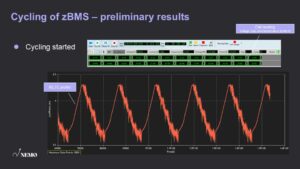
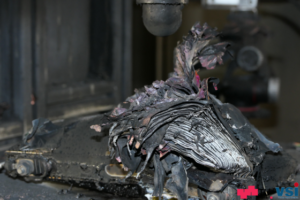
The NEMO project has successfully reached an important milestone with its zBMS demonstrator acquiring one month of operational data. The zBMS is designed to address the limitations of traditional battery management systems, which often rely on limited data and semi-empirical models. By integrating advanced sensor technologies, including electrochemical impedance spectroscopy (EIS), the zBMS platform aims to capture critical data on the battery’s internal electrochemical processes. By combining EIS data with advanced models, the project aims to deliver more accurate state of charge (SoC), state of health (SoH), and state of temperature (SoT) estimations.

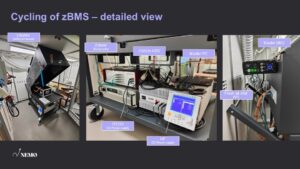
Two prototypes based on the zBMS architecture have been prepared by IAV and provided to CSEM and, over the past month, the zBMS demonstrator has gathered crucial data under the supervision of CSEM for this milestone.

CSEM is in charge of several activities in the project, including:

  • zBMS and zBMS+ testing using CSEM’s testing equipment, such as battery cyclers and reference EIS systems.
  • Hardware development, developing the zBMS+ slave modules and cell-switching solution.
  • Algorithms development, and validation of EIS-based SoT, SoC, and SoH estimators. These estimators will be used in combination with the zBMS and compared to conventional estimators. The goal is to demonstrate the benefits of EIS-based estimator recalibration. Additionally, an algorithm for SoH-based cell balancing will be developed for the zBMS+, acting on the cell-switching. Our aim is to demonstrate that smart cell balancing (based on SoH) will extend the pack’s lifetime.
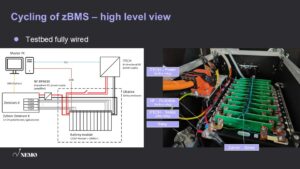
In terms of progress so far, the SoC and SoT estimators have been developed, and the SoC has been integrated into the TTTECH cloud platform. The hardware, including the EIS board and cell-switching board, has been designed and incorporated into the zBMS+ platform in collaboration with IAV.

The final objective is to demonstrate the advantages of the EIS-based recalibration for SoC, SoT, and SoH estimators, ultimately aiming to license these solutions. This will be achieved in combination with the developed hardware, particularly the switching and EIS boards, to advance battery management system technology.

—
About CSEM
Inaugurated in 2023, CSEM’s Battery Innovation Hub consolidates all key competencies necessary for battery technology in a single location. CSEM develops and tests innovative solutions in coin cells before scaling up to pouch cells. CSEM also develops innovative sensing solution and BMS. The facility features several climatic chambers and testers for both cells and packs, enabling comprehensive evaluation. Additionally, CSEM engineers are actively engaged in advancing battery management systems, focusing on enhancing SoX estimations.
background image of this landing page
website logo - back to homepage

The NEMO Newsletter is out!

The latest NEMO project newsletter is now available! Dive into the progress, achievements, and collaborations driving the development of next-generation battery models.

Here’s what you’ll find inside:

  • Project updates: learn how NEMO is advancing benchmark and demonstration tests for battery model development, with insights from project partner Graz University of Technology (TUG).
  • Collaborations: discover our involvement in the BRIDGE Initiative and the newly-formed BMS Alliance, fostering innovation and synergy across Battery Management Systems.
  • Events: join the conversation with the #EUSustainableBatteries campaign and find out where to meet us at upcoming events!

Watch our project presentation video and download the leaflet to explore NEMO’s mission and progress in ensuring performance, durability, and sustainability in battery technologies.

Stay informed and follow us on LinkedIn and BlueSky for real-time updates.

Read the newsletter now, and subscribe!

background image of this landing page
website logo - back to homepage

NEMO advances benchmark and demonstration tests for battery model development

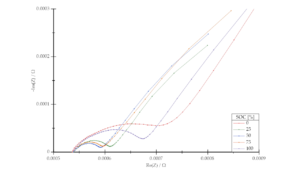
The NEMO project is advancing battery management systems (BMS) by developing advanced models to improve estimation of State of Charge (SoC), State of Health (SoH), Remaining Useful Life (RuL), and failure detection, aiming to extend battery lifespan. The operational zBMS system is actively collecting data essential for model validation, with a defined cycling protocol as a baseline for upcoming zBMS+ tests. Additionally, project partners have gathered electrochemical impedance spectroscopy (EIS) data under various conditions, including temperature, battery types, and aging states, to ensure the models’ robustness.

Nyquist Plot of exemplary EIS measurements with the selected NEMO battery cell

Nyquist Plot of exemplary EIS measurements with the selected NEMO battery cell


To ensure their effectiveness, NEMO’s models must operate under various conditions and undergo rigorous validation.

A key advancement in the project, reported by the WP7 leader Graz University of Technology (TUG), is the development of a framework for standardized data storage in the cloud. This framework facilitates easy access to data for the models and simplifies the comparison of measurement results. Furthermore, the EIS measurement chip has been validated through comparison with an external EIS measurement device, ensuring accuracy in data collection.

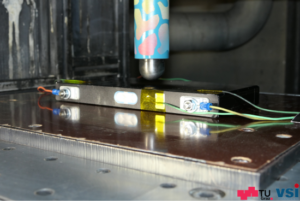
The project has also begun initial abuse tests at TUG to develop a failure detection algorithm, enhancing the robustness of the battery management models. Several single battery cells at a SOC of 75% were mechanically abused under laboratory conditions with a hemispherical indenter until occurrence of internal short circuit and thermal runaway at the Battery Safety Centre Graz (BSCG). Measuring the voltage, temperature, indentation force and indentation depth serve as a basis for the following investigations including EIS measurements of battery cells at different levels of uncritical deformation to connect the level of deformation with variations in the electrical battery cell properties.

Picture of the test setup before the local mechanical abuse test at 75%SOC

Picture of the test setup before the local mechanical abuse test at 75%SOC


Picture of the cell after the local mechanical abuse test at 75%SOC

Picture of the cell after the local mechanical abuse test at 75%SOC


Looking ahead, the next steps for the project include the preparation of the zBMS+ system and further testing activities. These will encompass aging campaigns with both cyclic and calendric aging (led by VUB MOBI), swelling experiments (conducted by TUG), and mechanical and thermal abuse tests (also by TUG). The zBMS will undergo cycling at CSEM, while TTTech will focus on cloud implementation.

  • VUB MOBI has started a calendric aging study varying the storage SOC from 50% to 100% and the storage temperature ranging from 5°C to 45°C to investigate the evolution of electric battery cell properties. Additionally, several battery cells are under a cyclic aging study including different aging conditions with varying temperature and charging/discharging profiles. Variations of the depth of discharge (DoD) and other parameters create the database for the aging models to be developed in WP4.
  • TUG measured battery cell swelling behavior under different conditions by measuring the evolution of battery cell thickness and force. Different constraints (unconstrained and different levels of preload force) were tested and will be linked to electrical battery cell properties to develop the mechanical swelling model within WP3 which allows for an estimation of the mechanical battery state.

Ultimately, the NEMO project plans to conduct a life cycle assessment to evaluate the environmental impact of the battery technologies being developed.

The importance of these benchmark and demonstration tests cannot be overstated. They will provide critical data for model development and benchmarking, validate the NEMO project’s key performance indicators (KPIs), and ensure that the developed models meet the project’s ambitious goals.

—
About TUG
Graz University of Technology plays a pivotal role in the NEMO project, leading efforts in multiple work packages. This includes the development of a mechanical swelling model based on EIS data (MSM), a State of Safety (SoS) estimator leveraging both physics-based and data-driven models for early failure detection (WP4), and leading the validation and demonstration activities within WP7. These combined efforts within NEMO promise to advance battery management technologies, ensuring safer and longer-lasting battery systems.

background image of this landing page
website logo - back to homepage

TU Graz showcases electric car battery research at “Lange Nacht der Forschung”

On May 24, 2024, the Vehicle Safety Institute (VSI) at TU Graz (TUG) participated in the Austrian-wide event “Lange Nacht der Forschung” (Long Night of Research), an initiative aimed at promoting research to the public. TU Graz set up an engaging stand and held a fascinating demonstration titled “What happens when an e-car battery reaches its limit?”

At the event, visitors had the unique opportunity to explore the pioneering work conducted at VSI’s Battery Safety Center (BSCG). Researchers there are dedicated to pushing the limits of electric car batteries, including abusive tests such as crashing batteries into a crashwall at 100 km/h to evaluate their resilience and safety. This hands-on approach not only ensures the safety of future electric vehicles but also contributes to the overall advancement of battery technology.

Patrick Höschele, Project Senior Scientist at the Graz University of Technology’s Vehicle Safety Institute, and his colleagues Christoph Drießen and Jun Yin, both PhD candidates, represented the NEMO project at the event.

Within the NEMO project, TU Graz is focused on developing a physics-based swelling model and a state of safety (SOS) algorithm, utilizing advanced techniques like electrochemical impedance spectroscopy. The Battery Safety Center at TU Graz facilitates precise validation tests for these SOS algorithms, using battery cells at 100% state of charge (SOC) in a controlled laboratory environment.

Attendees of the Long Night of Research were invited to visit the Vehicle Safety Institute station, gaining firsthand insights into the innovative methods and safety measures being developed to enhance the performance and safety of electric car batteries. This initiative highlights TU Graz’s commitment to cutting-edge research and its practical applications in the real world, contributing to safer and more reliable electric vehicles for the future.

Patrick Höschele, Christoph Drießen and Jun Yin at the Lange Nacht der Forschung in Graz (Austria)

background image of this landing page
website logo - back to homepage

NEMO unveils aspirations for advancing battery management systems in new presentation video

Towards addressing challenges in battery management systems (BMS) for electric vehicles and stationary storage, the NEMO project has introduced its innovative approach through a newly released presentation video.

The video underscores the importance of efficiency and safety in battery operations, pointing out the limitations of existing BMS that often rely on a limited amount of observed data and simplified battery models. This European project seeks to overcome these challenges by advancing BMS with a combination of new hardware and software concepts, leveraging in-situ and in-operando electrochemical impedance spectroscopy (EIS) sensing, along with active cell switching for balancing at cell-level and sufficient computing power to execute real-time advanced models and algorithms.

NEMO’s video introduces its ambitious goals, including the prediction of critical issues unrelated to severe mechanical impacts, extending first-life battery duration by at least 20%, and capturing failure modes with 100% accuracy. By focusing on advancements in digital battery management, NEMO aims to position the European BMS industry as a leader in innovation.

As the project is still in progress, viewers are encouraged to stay connected with NEMO through its website and social media channels to receive updates on developments and milestones.