How EIS-driven BMS can shape future battery systems
During the lates NEMO webinar, experts from VUB, Infineon, IAV and TTTech discussed how Electrochemical Impedance Spectroscopy, next-generation BMS architectures and cloud–edge cooperation can make battery systems safer, smarter and longer-lasting.
On 30 September 2026, the NEMO project hosted its online webinar “EIS-driven BMS for Future Battery Systems“, focusing on the hardware and data side of the project’s results. Moderated by Md Sazzad Hosen (VUB, project coordinator), the session brought together experts from Infineon Technologies Austria, IAV and TTTech to discuss how advanced sensing and battery intelligence can support automotive and stationary applications.
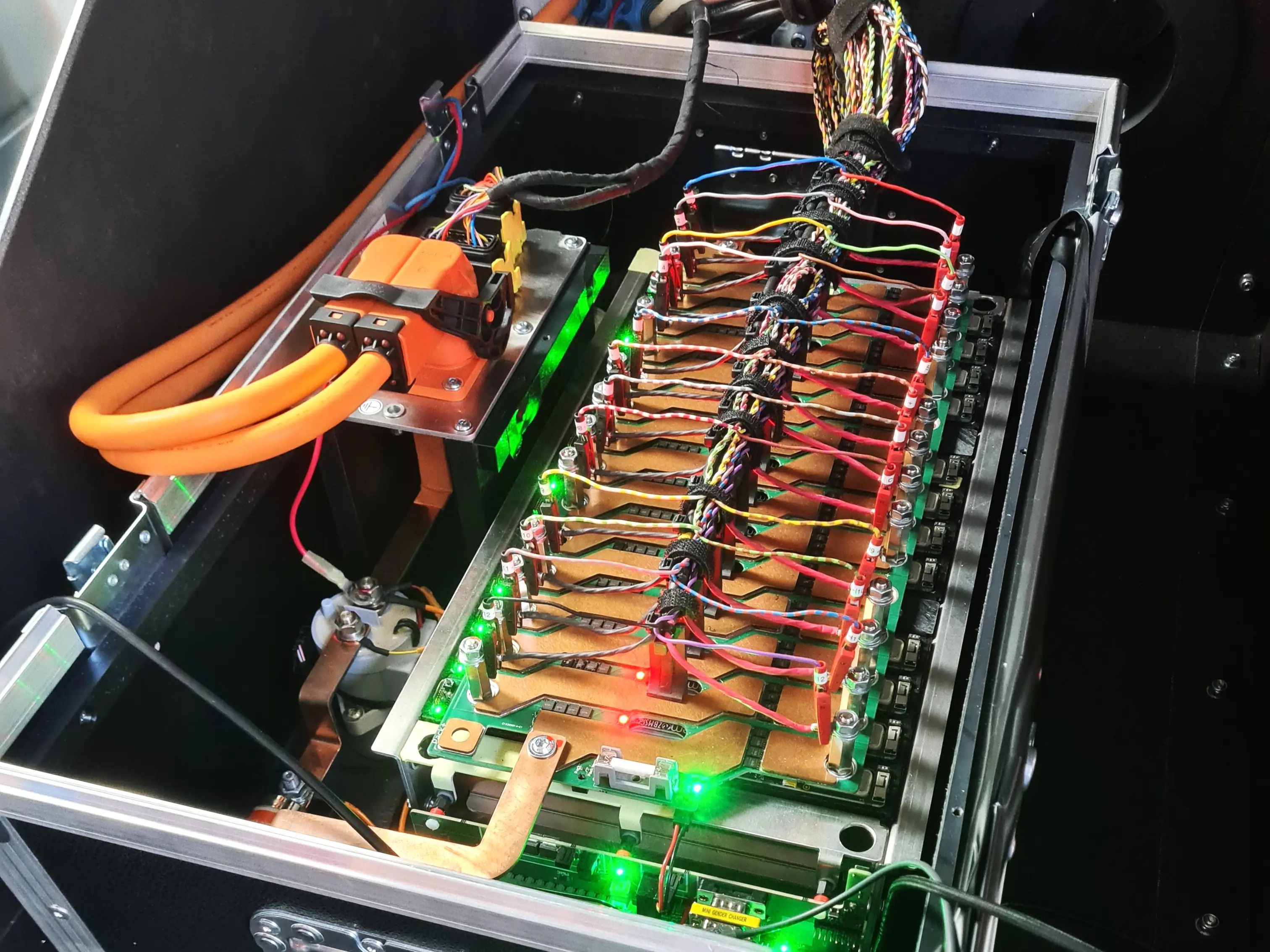
Guenter Hofer (Infineon) explained how Electrochemical Impedance Spectroscopy (EIS) goes beyond conventional voltage, current and temperature measurements, offering a frequency-dependent “fingerprint” of the cell’s internal state. He presented the single-cell impedance measurement prototype used in NEMO, which delivers accurate magnitude and phase results per cell. He also noted the challenges of real-world implementation, such as cost, wiring and synchronisation in large battery packs, and recommended focusing on the most sensitive frequencies for specific use cases rather than measuring the full spectrum.
Thomas Percz (IAV) described how NEMO translates sensing and modelling capabilities into a production-oriented BMS architecture. A conventional BMS remains at the core to guarantee safe operation and provide a reference for benchmarking, while additional computing resources, a framework for integrating partner algorithms and a high-speed cloud interface enable the new EIS-based functions to run without interfering with core safety functions.
Bernhard Lutzer (TTTech) outlined how intelligence should be distributed across the onboard BMS, the edge gateway and the cloud. Safety- and time-critical functions must always remain on board, while fleet comparisons, historical analysis and model recalibration can run asynchronously in the cloud. He also stressed that cloud outputs must be validated before being trusted, and that the system must continue to operate safely when the connection is unavailable.
Presentations were followed by a panel discussion and Q&A. The panel agreed that EIS is likely to play a growing role in future BMS, with cost remaining the main driver for market uptake. Discussions also covered cybersecurity and data trust in cloud-connected systems, the limits of moving EIS from cell to module level, and the opportunities and challenges of wireless BMS in electromagnetically noisy battery environments.
What’s next?
As NEMO approaches its conclusion, the project will present its final results at its closing event in Milan. Register now and join us in Milan!


